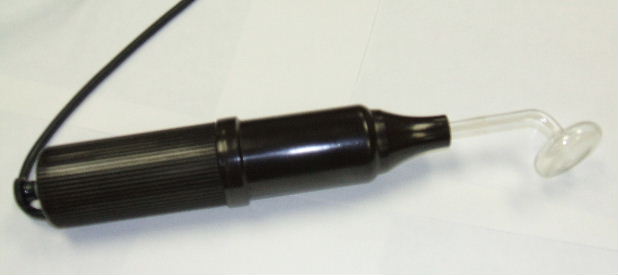
Typical modern Violet Ray device, allegedly invented by Tesla
At every step of research, those who have been attempting to create new power generation
technologies have noticed something. All methods of power generation have medical effects.
These effects correlate with the relative consciousness level of the method. For example, we
all know what happens to someone involved in coal burning, at almost any level. That includes
those who live near generation plants. A few types of fuel are less healthy than that, and a
few are a bit better. Tesla told us that we shouldn't be burning fuel anyway.
A few more recent methods are really bad for health. Nuclear power, which still is a kludge
that uses heat from decaying matter to boil water for turbines, can only exist in a climate of
fear, totalitarianism, and information blackouts. Waste materials and emissions from these
plants are obviously unhealthy, and in fact include some of the most poisonous substances in
the universe!
Research into ball lightning has induced insanity in several people. Even though the background
math is excellent, it would be best to abandon this line before anyone else gets hurt.
Note how Nikola Tesla lived a very long life in excellent health. Anything he researched and
patented deserves further development. According to Ralph Bergstresser, Tesla was fascinated
by the "Tertiary Coil". He said that a third coil could be placed on top of a normal Tesla
coil and charged up. Then, it could be taken elsewhere and would emanate beneficial subtle
energy for a long time. Tesla kept one of these on his bed headboard all during his later
life and said it helped him. Several of the electromedical technologies on this page
also have potential for power generation.
ELECTROMEDICINE
Nikola Tesla invented some electromedical devices. The basic theory is that small amounts of
electricity will have an effect on many conditions. Effectiveness of this technology has been
demonstrated in many ways. One of his devices, the so-called "Violet Ray", is currently available
through a number of sources. It puts out a stream of purple radio-frequency electricity through a
glass bulb directly into the skin. Small tumors and cysts in animals have been observed to disappear
within a few days after treatment. Other benefits have intermittently been reported by users.
Tesla's work was a precedent for later developments. After about 1910,
the term Diathermy was applied to this field as many variations came to market.
Several researchers have developed good equipment since then, both diagnostic and treatment oriented. We should
keep in mind that for most researchers and practitioners, the fundamental ideas behind electromedicine
are different from normal American medical practice. Electricity should be used to strengthen
the body, allowing it to naturally heal. This is not a war against diseases or specific organisms.
Ideally any destruction of a pathogen should be accompanied by a corresponding buildup of living body
cells. Pharmaceutical products, on the other hand, are designed to either kill off pathogens
(which can't be done with viruses so far) or alter a human body process in some specific way. Thus
it often happens that pharmaceuticals end up working against each other.
Electromedicine is a broad set of methods that should combine well with other natural practices such
as nutrition and herbs.
Typical modern Violet Ray device, allegedly
invented by Tesla
One of the most well-known electromedicine inventors was Royal Rife, who was active for many years
starting in the 1930s.
His achievement was to build electro-optical microscopes along with several types of frequency
generation machines.
These were far ahead of his time. In fact he got into a lot of trouble for this research, went on
trial twice, and died
in jail. In recent years many people have built treatment devices based on his designs, but nobody
has yet managed to duplicate the microscope. However, some good diagnostic equipment has been
developed based on new software for PCs.
Basic theory behind Rife's work is somewhat different from normally accepted medical assumptions.
He believed that most, if not all infectious agents changed form under various conditions. At one
point the agent, known as a somatid, could be a bacteria, at another, a virus, and at still another
a mold. Diagnosis consisted of finding the frequency of whatever was causing problems in a patient
in its current form, using live tissue analysis under the microscope. Then, once the correct frequency
was fed into the patient's body, the agent, whatever it was, would be neutralized. This theoretical
basis has been replicated and extended by Gaston Naessens in Quebec.
Without diagnostic equipment, making treatment machines involves some trial and error. That said,
many people have reported good results with a number of different models.
A further development of these principles was the Multi-Wave Oscillator (MWO) invented by
Georges Lakhovsky. Many advancements and refinements of this technology have come along since. Any
MWO, as the name implies, will broadcast over a short range a wide variety of electrical frequencies.
Many MWOs are set up so that a person sits between two bradcasting coils. Some people report
excellent results with this type of machine. Others report no effect at all, and a few have said
there are negative effects. A few small companies currently make versions of MWOs.
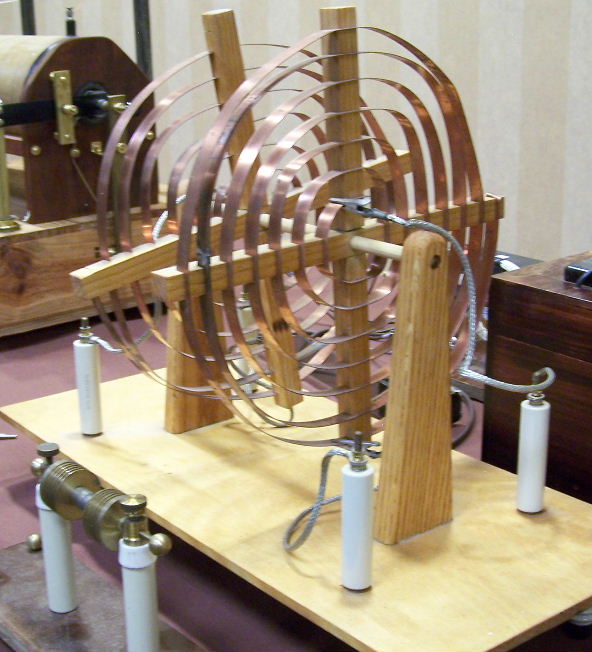
Replica of an old MWO
Pulse technology has been known to produce good results. Very low-power pulses of electricity fed into the blood or body tissue seem to disrupt the action of many bacteria, viruses and other pathogens. One of the best devices of this type was produced by the late Dr. Glen Gordon
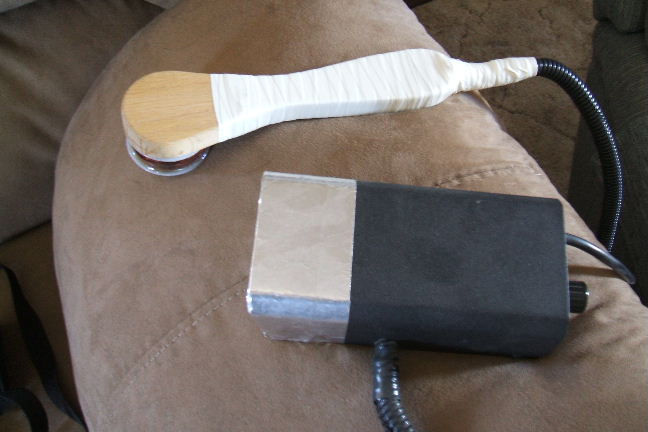
Home-made pulse device
Another workable approach in electromedicine is to use a broad range of frequencies that can benefit almost anyone. Several groups have found such frequency sets and transmit them through a Multi-Wave Oscillator (MWO), specially tuned Tesla coils, along with gas-filled tubes and other innovations. Several research studies are indicating that free radicals are reduced and beneficial hormones are increased for a majority of people who use this type of machine. Sessions are informal, usually involving a person sitting near a machine for less than 5 minutes. Recently it has become customary for some people to drink water that has been exposed to the machine's fields. At the time of this writing, the most well known and refined device of this type is:
VIBE Machine
Gene Koonce
Greeley, Colorado
(800)356-9594
www.vibemachine.com
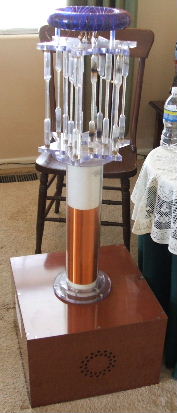
Typical VIBE machine installation
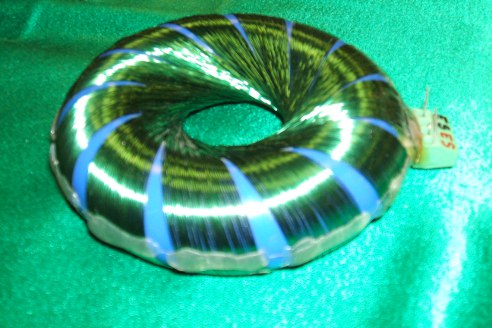
This Toroidal Coil winding reportedly
was involved in a dramatic reduction in anticipated healing time for a man who was wounded
in a small explosion with second and third degree burns. Reference: Marko Rodin presentation
at the 2011 ExtraOrdinary Technology Conference available through
Tesla Tech, Inc.
Many electromedicine pioneers operated during the 1920s and 30s, mostly inspired by Tesla.
Their work has been collected into an excellent museum which exists both online and in the real world.
You can find it through:
Jeff Behary
The Museum of Electromedical Devices
West Palm Beach, Florida
Interview with Electromedicine Pioneer Bob Beck
Outline for Electromedicine Manual
Tesla Academy
Michael Riversong
P.O. Box 1891
Fort Collins, Colorado 80522
(307)635-0900
mriversong@earthlink.net